It's that subject that I want to talk about today. That subject was (and still is!) called Conceptions of Giftedness, Intelligence and Creativity. A bit of a mouthful right? Basically, whilst the intelligence and creativity parts of the title are clearly important, the subject really focusses on working out what giftedness actually is so that we, as professionals, can advocate for the gifted kids in our classes, schools and communities.
It's a bit of a touchy area for me because my two children are gifted.
Until a few years ago, I raised them as a single parent, just the three of us. My whole experience of parenting was with gifted children: meeting developmental milestones scarily early; dealing with their incessant need for challenge and learning; advocating for their special (yes, special) needs; supporting them in the areas that lagged behind their intellectual and creative development; conversations about anything from nuclear fusion to the medieval English serfs' use of non-arable land; the need to manage social activism from one son who wants to save the world (whilst happily ignoring problems closer to at home). This was my norm and, as such, I never once considered that it might be different to any one else.
Then I married a man with four sons of his own. I discovered, very quickly, that there is a huge difference. I could write a thesis on the ways our two groups of boys are different. Some of the differences are simply down to different families of origin but most are not. Most stem from the differences in the way the boys experience, perceive and interpret the world. There's nothing inherently superior in either way; in fact there are 6 different ways because there are 6 different kids. There are undeniable differences though.
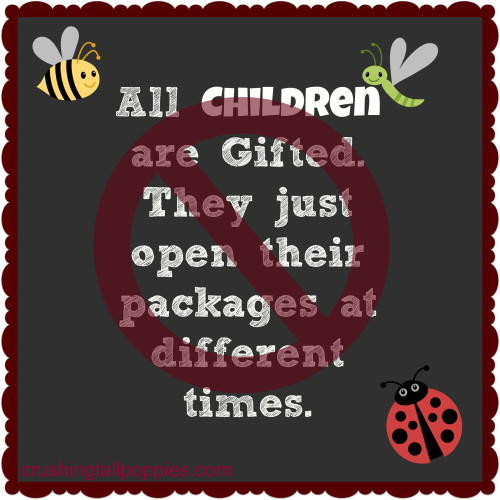 |
| This blog post, over at Crushingtallpoppies.com, shares my frustration with this myth. |
I'm sharing these details of my life because one of our assignments requires us to rebut and then positively reframe myths about giftedness. And... As a parent of gifted children I'm finding it really hard. The first myth we addressed was that all children are gifted. *internal scream* No. They're not. All children are unique, but they are NOT all gifted. I witness this truth every time I sit at the dinner table with our combined tribe and hear the disparity in conversations. I see it every time I look at the learning tasks of my 14yo gifted son compared to my 14yo stepson. I feel it as I see the frustration in my son at the way his stepbrothers skate over the surface of something he wants to share deeply. I know it in my bones as a mother. Right there, that's where I'm having trouble with this. I'm struggling to step back and be a student rather than mama bear.
Anyone who has seen me with my other kids - the ones who call me Mrs RP - knows that when advocating for them I'm often in full mama bear mode. With these kids I guess it's a bit different though. As Rita Pierson eloquently describes it, I'm acting as their champion. This is different to being mama bear in many ways, but overlaps in others. Is this why I'm struggling to make the distinction between mama bear and student? The overlap? I don't know but I have a sneaking suspicion that it's something I'll struggle with in all of my studies about giftedness because it has been such a big part of my role as a parent.
I didn't expect to be so emotionally challenged by my first subject but I can tell you that it has pushed me further and deeper into my readings than I expected so it's probably a good thing. Some might even say it's a gift. Ha!
This relates to the following Australian Professional Standards for Teachers...
Standard 6 Engage in professional learning
Standard 7 Engage professionally with colleagues, parents/carers and the community
Standard 6 Engage in professional learning
Standard 7 Engage professionally with colleagues, parents/carers and the community

