Saturday, 17 August 2013

Fleeting (or Floating?) Resources

Unlike many teachers I LOVE planning. I love posing a question and trying to create a framework through which my class can work toward answering it, or at least demonstrate some understanding of the importance of it. I love the challenge, the creativity, the myriad new things I learn... I love it all.

(Of course, we all know that the best laid plans often go astray and that's OK. In fact often it's more than OK, it's fantastic, because it means the students have taken charge of their learning and are taking it where they need to go.) 

Anyway, back to what I was saying... I love planning. I'm regularly amazed at the brilliant resources we have at our fingertips these days.  Check out these great history sites I have discovered recently in my planning of a unit about the voyage and arrival of the First Fleet (For my non-Australian readers: the First Fleet refers to both the actual ships of the first fleet sent by England to Australia in order to transport convicts, and the stories associated with that era/series of events.):
  • Convict Records of Australia: this site gives access to the British Convict Transportation Register with sections about the crimes committed, the individual ships, a timeline, a search function AND best of all tables of data about the convicts that double as a maths resource. 
  • Convicts to Australia, A Guide to Researching Your Convict Ancestors: this site hosts a plethora of interesting links (to First Fleet and convict related information) and quirky little stories. If you don't happen to have any convict ancestors (or any of which you are aware) this site has a fun little app that allows you to create your own. Here's mine...
  • First Fleet Arrives 1788: this is an interesting YouTube clip that addresses the arrival of the First Fleet from a more Indigenous perspective. 
  • Sydney Living Museums: this organisation aims to educate Sydneysiders about history from an insider's perspective, and along the way have put together a fantastic web resource as well. I particularly enjoyed 'A day in the life of a convict'.
  • State Library of NSW First Fleet: this page is a wealth of information but the highlight for me is the animation of the First Fleet's journey on a world map. We watched this as a class, pausing at various points to add to our own maps and discuss why the First Fleet may have stopped at various places. We started the discussion by marking on a world map the various ways we thought the voyage might have gone and compared those predictions with reality. LOVE this animation.
  • My Place for Teachers: as you would expect this is linked closely with the television series. Some good information though.
  • First Fleet Provisions: this site gives a detailed provisions list. Fascinating!
  • First Fleet Convict Dataset: this is a very comprehensive and searchable dataset of the convicts on the First Fleet. Again, awesome cross curricular potential.
  • The First Australians: a brilliant treatment of the First Fleet's arrival from an Indigenous perspective. 
So many more to mention but these are a great start. I have more on my Pinterest 'Classroom Coolness: History' board. I'd love to hear about others. What's your favourite First Fleet resource?

This relates to the following Australian Professional Standards for Teachers...

Standard 2.2 Content selection and organisation
Standard 2.4 Understand and respect Aboriginal and Torres Strait Island people to promote reconciliation  between Indigenous and non-Indigenous Australians
Standard 34 Select and use resources


Friday, 16 August 2013

Sharing time...

l'm pretty sure that all of my early school reports said something along the lines of 'does not share her toys well'. I've changed my ways considerably in the interim BUT there are times when even I question my sharing abilities.  More precisely I, sometimes, question whether I have the courage it takes to share.  Perhaps I'm not brave enough to share possible weaknesses?

It doesn't take a particularly skillful psychic to see where this post is going when you consider that, as I've previously mentioned, I'm currently sharing a class. It's a minefield of possible stressors but not necessarily in the way you might imagine. 

I have no issue with sharing the responsibility for this class with my co-teacher. In fact that's quite welcome. I have no issue sharing space with her either. (She's neat, tidy and quite organised: what more could I ask for?) Or even ideas. I LOVE that side of sharing. What's a little scary for me is that I'm constantly sharing my teaching practice in a way that I've never done before. Everything lesson I teach, every activity I design, every piece of work I set is right there on display! Open to be judged and interpreted and... Argh!

I guess it's a good kind of scary though. It's the kind that drives learning and development. So... a'learning I will go. Here are my learning goals (in just numeracy and literacy) for the rest of this term.

Numeracy
  • I want to learn ways to use our available technology to support my numeracy learning program (this is linked to my inquiry question for my staff PLC)
  • I want to learn how to better include reflection in our maths (and other) lessons (we follow Ann Baker's Natural Maths pedagogy so this is particularly important)
  • I want to learn how to create high quality assessment tasks (this is a focus for our staff, and I'm really enjoying the challenge)
  • I want to research ways to help our lower achievers develop better basic number sense (it saddens me to see the depths of the struggle for some of them).
Literacy
  • I want to learn more about teaching explicit strategies during guided reading (I'm still finding my feet with guided reading so am very keen to learn more)
  • I want to learn how to better enable to children to use the resources available to them when creating their own written work (there are LOADS of resources available, I want to work out ways of better encouraging the students to independently use them rather than ask the adults)
  • I want to learn how to use Edublogs WELL (we've set up a class blog and the children are all very excited so I'm keen to leverage this tool to support strong learning outcomes)
  • I want to research ways to make proofreading an automatic part of our writing process (they're grade 3/4... they're learning to proofread but I want to find tools to help them do it more independently and spontaneously).
Clearly I can identify about three gazillion more things I need to learn in these (and other) areas BUT these are my goals for this term. I'll check back in during the holidays with my progress. In the meantime, I'm keen to hear tips and advice on how to cope with my stress about sharing...

This relates to the following Australian Professional Standards for Teachers...
Standard 6.1 Identify and plan professional learning needs
Standard 6.2 Engage in professional  learning and improve practice
Standard 6.3 Engage with colleagues and improve practice
Standard 6.4 Apply professional learning and improve student learning


Thursday, 8 August 2013

It's War!

Early this week our class declared war. Well, not really but it was fun pretending.  As part of a whole school 'Maths Games Day' we ran an 'Addition War' stall and decorated it with genuine army gear (for which I must thank my dear friend +Adrienne Kajewski). Aside from our stall looking awesome...

Our class ROCKED the day with awesome attitudes, about the event and more importantly about maths!

My co-teacher is, amongst other things, the school's maths co-ordinator so this event was her baby. She did a great job. The school gym was split in half with dividers and each half was set up with tables around the perimeter (oooh look at the maths language). In the days/weeks preceding Maths Day each class chose a maths game to learn and then teach the rest of the school.  (Our class tossed up between three games but the competitive nature of most of our kids - and both teachers if I'm completely honest - meant that War was always going to win.) Over the course of the day each class was rostered to visit the gym and learn the games. Each class also rotated through student 'experts' to man their stalls.

The range of games the classes presented was great. The 'expert' helpers from each class really stepped up and were wonderful ambassadors for their class. Our kids went to town with our 'theme' and presented to the stall with war painted faces. (Between you and me, the war paint was my strategy for quickly determining who had already had their turn as an 'expert'... I painted them just before their alloted time.)

Have you ever played Addition War?   It's simple really: 
Our 'take home' instruction slip
  • Remove jokers from a deck of cards and evenly distribute the remainder amongst players (the more players the more challenging the game). 
  • All players place their top card on the table face up.
  • All players compute the total of the cards' value (2-10 = face value, J-K = 10, A = 11) and call out the answer.
  • The first player to call out the correct answer wins those cards and places them to once side.
  • Play continues in this manner until player run out of cards.
  • The player with the most cards is the winner. 


This game is pretty easy to differentiate in both directions. For students who are struggling: reduce the number of players; remove specific cards (I'd start with the aces); provide scaffolding support (posters with rainbow facts etc.) for starters. For high fliers: instead of addition try multiplication; have each player place down two cards and add the resultant double digit numbers; have each player place down two cards and subtract the lowest resultant double digit number from the other. 

Disclaimer: our student teacher introduced this game to our class and taught them how to play.

This relates to the following Australian Professional Standards for Teachers...
Standard 1.5 Differentiate teaching to meet the specific learning needs of students across the full range of abilities;
Standard 2.1 Content and teaching strategies of the teaching area
Standard 2.5 Literacy and numeracy strategies
Standard 3.5 Use effective classroom communication
Standard 4.1 Support student participation

Tuesday, 6 August 2013

What's for dinner? Hang around and my class will tell you.

The last couple of weeks have been an absolute roller coaster for me. I've started my new contract and LOVE my class. I think I've mentioned how excited I am to be working with my 'co-teacher', but I'm going to do it again: she's amazing! So much drive and energy! And just a never ending pit of knowledge. I'm like a pig at a trough sucking it all up. (Yep, there's an image you won't get rid of for a while. Sorry!)

We also have a pre-service teacher (student teacher) in the room for the first four weeks of term.  We're all comfortable in acknowledging that it hasn't all been smooth sailing so far but it has been a time of huge growth for us all and  we've definitely hit calmer waters now. It's been fascinating for me to reflect on how much my teaching practice has grown in the past year. 

One things I'm particularly enjoying is the fact that this classroom - in fact this whole school, - follows Ann Baker's maths pedagogy. (In fact today instead of a staff meeting we had a 90 minute professional development session linking her pedagogy to the new national curriculum. Gotta love a school that prioritises ongoing professional development!)

Our numeracy blocks typically follow her pattern of:
  • a mental routine
  • the main part of the lesson (such as strategy teaching or a problematised situation)
  • reflection.
Possibly the most powerful part of this, for me, is tackling problematised situations. In a nutshell we offer problems that have their basis in real life, in ways that the students can relate to, and are engaged by.  The students then use their own (or shared) strategies to find possible solutions. It's a fascinating process that allows the students to apply their understandings and offer reasoned options. 

We're currently working on a rather large situation that involves my class  working toward making recommendations about what I should feed my (six) children. I presented the problem:
I just recently got married, and there are now six children in my family. Yep. Six. They all like different foods. Dinnertime is an absolute nightmare. I don't know how to manage this situation. I wonder if you could help me figure it out?


And  threw it open to them. We're working on data at the moment so they very quickly established that I needed to ask 'a bunch of questions'.  They then provided me with 176 questions to take home to ask the boys. (Oh yes, all six kids are boys.)  There were many repeats and so I ended up with ten questions and related answers.


On presenting this data to the class I commented:
That's lovely but it's not overly helpful. It's a whole bunch of words and numbers on a page. I still need your help.


So now they're all analysing the data to make recommendations.  Each at their own level of understanding.


I've seen tallies, tables, graphs and a few things I can't quite name.


Some students are using information from one question to help shape their recommendations based on other questions. It's AMAZING.

 Now my challenge will be to keep coming up with awesome problematised situations. I realise they don't all have to be this grand,  in fact I'd prefer they weren't, but the challenge is on.  I'd be happy to hear your suggestions.

If you haven't read about, or heard of Ann Baker head over to her website and check her out. I've bought a few of her books and am finding them to be a wonderful resource.


And here's the new bit to my blog. I'm going to try to link my posts to the Australian Professional Standards for Teachers. Feel free to ignore this part if you wish.

Standard 3.1 Establish challenging learning goals; 
Standard 3.2 Plan, structure and sequence learning programs; 
Standard 3.3 Use teaching strategies; 
Standard 4.1 Support student participation; 
Standard 6.2 Engage in professional learning and improve practice; 
Standard 6.4 Apply professional learning and improve student learning.

Sunday, 14 July 2013

Alphabet posters

I had a contract earlier this year with, as I mentioned last time, a group of wonderful 5 year old people. I walked into this class with no background knowledge other than 'their regular teacher was away on a cruise and the teacher originally booked to cover this period had a family tragedy and was, at the last minute, unable to take the class'. I had all of one day to prepare so our first day together was a whirlwind of formative assessment couched as getting to know you activities.

I'll admit that I found my first day in this class terrifying! Aside from walking in with only generic plans (and feeling woefully under-prepared), these children had already experienced a week of a relief teacher and come from a community that doesn't welcome strangers particularly readily.  Let's just say that they didn't share my enthusiasm for getting to know each other. And why should they? They already knew each other!

That being said, we pretty quickly settled into a routine of morning literacy and numeracy blocks.  We ran explicit class discussions followed by 5-6 work stations through which the children moved.  Several mornings each week I was incredibly lucky enough to have in-class support for the two children with special needs. This allowed me to work with small groups in 'guided reading' type activities. (In as much as guided reading is possible with children who are still in the early days of letter/word recognition.)

One of all of our favourite literacy stations was creating alphabet posters. We made a few varieties ranging from cutting jumbled letters and pasting them into order, to a space themed poster (letters were written on stars and planets) during our space week.

Everyone's favourite poster was inspired by a pin that you can see here. (What a surprise that I found inspiration on Pinterest!!!) It was basically a grid with each 'hole' containing a letter written in a different colour crayon and painted with a water colour wash.


 It's not a particularly difficult process but it does take lots of patience because there are a few steps.

  1. Draw the grid. (I draw one before class and photocopied it because I know myself well enough to admit that I simply do NOT have the patience to have helped every child with theirs individually, and also to admit that I'm a perfectionist and wanted these to have reasonably regular grids.)
  2. Write the letters in each hole. We wrote ours in pencil first and then traced over with crayon but if you're brave confident enough you could go straight to crayon.
  3. Trace over the grid lines with crayon. (I had to help some of my little guys with this because drawing along the edge of a ruler actually requires quite some fine motor control.)
  4. Carefully paint each grid hole with different coloured watercolour paint. If you're a perfectionist (like me... Are you starting to sense that this was not the best project choice for me?) then it's best to walk away at this point because if you're working with 5 year olds they WILL use too much water/paint and the colours WILL mix. I worked REALLY hard to keep smiling and calmly repeat "not too much water, wipe your brush on the edge" over and over and over and over... In the end the children did a marvellous job and I was able to breathe easily again.
 When I photocopied the grids I also trimmed the pages a little so that I could mount them on coloured paper more easily. We thought they looked great.

What's your favourite alphabet art activity?


(Art Projects for Kids is the blog where this project was originally published and is quite brilliant, but I suggest you make a cup of tea and pull up a comfy chair because it's a treasure trove so you'll want to settle in for an afternoon of oohing and ahhing!)

Friday, 12 July 2013

Shooting for the stars Mach 2.

Some of you may remember that I taught a unit of work about space to a group of reception children last year. I loved it. They loved it. Happy dances all around.  (If you can't remember, or never read about it, you can here.) Since then I've put together a much more involved grade 5 unit of work on space and have pinned about 9 gazillion awesome space resources (they're spread through my Classroom Coolness: Science board if you're interested). I've also revisited my reception unit of work with another class.

Let me set the scene: towards the end of the third week of a four week contract, in another reception class, the students were using their bodies to make letter shapes and I was using my tablet to capture their attempts. The students reviewed the photos and modified their letters as they saw fit. Being five years old these students were, naturally, curious to see the other photos on my tablet and so they stumbled upon the photos of my first space unit*. (Remember those cool photos of the children creating a solar system with their bodies? That's what piqued my class' interest.) 

"Why did you teach them about space? When are you going to teach us?"


Well there's actually no answer to those questions that are acceptable to most 5 year olds!  We had one more week together and no pre-arranged commitments so I threw caution (and my plans) into the wind and announced that the following week was to be Space Week. 

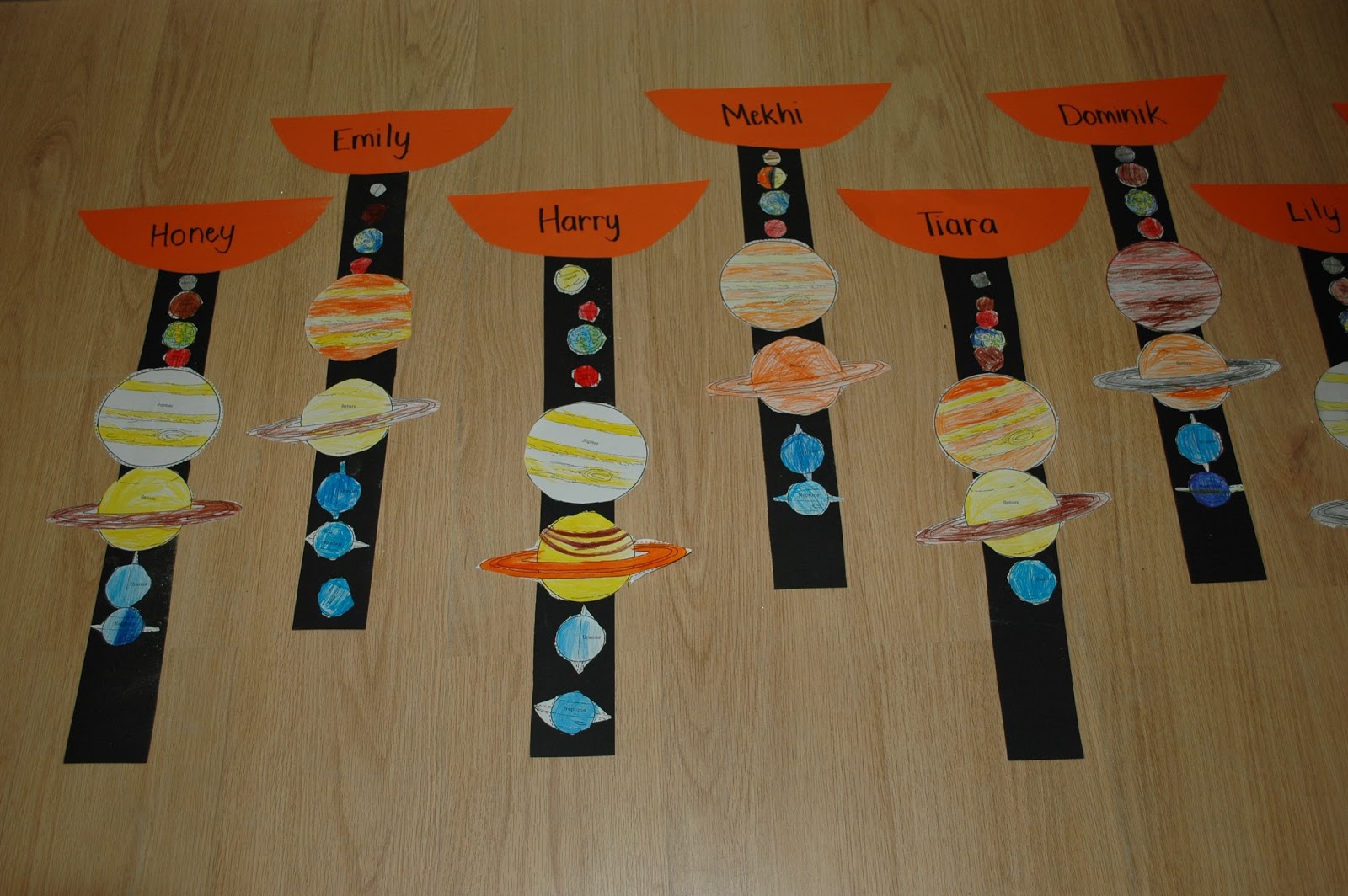
We completely immersed ourselves in learning about space, becoming space explorers who visited at least two planets a day. We read, wrote and drew about stars and planets. We created art work and made human models of the solar system. It was, like last time, a fantastic experience.  

How was it different to last time?

  1. We concentrated on Space (to the exclusion of everything else) for one week instead of focusing on it for a session a day over four weeks. There are advantages to both, but I understand that this way is certainly not often possible or desirable.
  2. The students were much younger (mostly in their first (or second for a couple) term of reception) and so relied more heavily on me for guidance with their writing. 
  3. The prior knowledge was much lower, so I started very differently. I used a community of inquiry approach to determining the prior knowledge. The students LOVED this experience because I talked it up as something that we, as teachers, use to share our understanding. They really stepped up to the plate and made sure their contributions were well considered. (If you've never used the community of inquiry method, here's a good place to check it out.)
  4. Our inflatable solar system.
  5. I approached the learning from a narrative perspective. Each day we climbed inside our space ship, put on our space helmets, buckled our belts etc., before zooming off to the next planet. I hung an inflatable solar system in our room so that we knew which planet we were looking for each trip. As we pulled up our space ship we made observations about what we imagined we could see and record these. We compared our observations with recorded information on posters, in books and on websites. We were often surprised at what we learned in these comparisons.
  6. There was less writing (although we wrote plenty - more than for the whole other three weeks put together!) and more art. These children LOVED their art. Check out some of these amazing solar systems they created.
    And some of the wall hangings:

  7. We went outside to create our solar system rather than drew it on the carpet. (Don't get me wrong: using chalk on the carpet is an amazing use of a very under-utilised space and we did loads of carpet drawing in this particular class BUT it was a sunny day so we went outside. Where better to pretend to be the sun than out in the sunshine?)
  8. Our leadership team bought into our explorations and often popped into the classroom to see which planet we were visiting. The children LOVED sharing their learning and showing off how much they'd learnt. (I loved watching them share their learning and showing off how much they'd learnt EVEN more than they enjoyed doing it.)
  9. We were able to share our learning with the other junior primary classes who all came to see our space journals, solar system hats, solar system wall hangings and art during one big exposition on the final day. Boy were we proud!
So, whilst it felt a little like I was cheating (because I was able to recycle a bunch of my resources and planning) my second space unit was really quite different.  I'm really looking forward to the opportunity to teach an older group about some space related topic. It's such a fun topic!

How do you teach about the solar system and space?

*I only use my tablet at school and am very careful around which photos remain accessible in this way.

Thursday, 11 July 2013

Another confession...

I have a confession to make: I've been putting off writing on this blog.  This past term I've been a relief teacher and, on more than one occasion, fell into the trap of thinking of myself as just a relief teacher which meant that anything I taught was just relief teaching and of little value.  It doesn't take a rocket scientist to see the implications that kinda thinking has for this blog.

You know what though? I'm not just a relief teacher. Or just a contract teacher. 

I. Am. A. Teacher. 

So, my months of self-doubt and questioning are over. A couple of shares to get this blog going again:

  • Remember how one of the things I love about relieving is learning from other teachers? Well, I recently stumbled over these photos that I took a few months ago. If you're a fan of  Look Say Cover Write Check as a spelling activity, this is an awesome way of doing it. Using an A4 card folded into thirds you can make neat little folders that can be stored easily and reused for the whole year (or quite some months at the very least.)

\

  • I taught design and technology (school wide) for a few days early in the school year.  One of the age groups made trioramas with models made from air dry glue (the recipe for which I found here on pinterest). I asked the students to show me something they did or somewhere they went during the holidays. 


  •  I took a four week contract in a reception class at the end of term 1 while their regular teacher was on long service leave. I was very conscious of leaving very clear notes about what we did while she was gone and so I started gluing small slips into the students' book explaining what we had done. I hand wrote specific notes about each child when I glued them in. I was particularly pleased to be able to communicate so clearly with the regular teacher about progress and  how I differentiated the children's learning activities. It took only a few minutes because I used my lesson planning notes. I hope to continue this practice as I move into my new contract.
    I think it also serves well in demonstrating my engagement with  a slew of the Australian Professional Standards for Teachers.
So, I'm back. I'm excited to be sharing a grade 3/4 class with an inspiring teacher. I have a .4 contract for the rest of the year and will also be available for relieving for the other three days of the week.  It's going to be a busy couple of terms,  but now that our house renovations are coming to a plateau for a few months it will be manageable. Stay tuned!