Showing posts with label Space. Show all posts

Friday, 12 July 2013

Shooting for the stars Mach 2.

Some of you may remember that I taught a unit of work about space to a group of reception children last year. I loved it. They loved it. Happy dances all around.  (If you can't remember, or never read about it, you can here.) Since then I've put together a much more involved grade 5 unit of work on space and have pinned about 9 gazillion awesome space resources (they're spread through my Classroom Coolness: Science board if you're interested). I've also revisited my reception unit of work with another class.

Let me set the scene: towards the end of the third week of a four week contract, in another reception class, the students were using their bodies to make letter shapes and I was using my tablet to capture their attempts. The students reviewed the photos and modified their letters as they saw fit. Being five years old these students were, naturally, curious to see the other photos on my tablet and so they stumbled upon the photos of my first space unit*. (Remember those cool photos of the children creating a solar system with their bodies? That's what piqued my class' interest.) 

"Why did you teach them about space? When are you going to teach us?"


Well there's actually no answer to those questions that are acceptable to most 5 year olds!  We had one more week together and no pre-arranged commitments so I threw caution (and my plans) into the wind and announced that the following week was to be Space Week. 

We completely immersed ourselves in learning about space, becoming space explorers who visited at least two planets a day. We read, wrote and drew about stars and planets. We created art work and made human models of the solar system. It was, like last time, a fantastic experience.  

How was it different to last time?

  1. We concentrated on Space (to the exclusion of everything else) for one week instead of focusing on it for a session a day over four weeks. There are advantages to both, but I understand that this way is certainly not often possible or desirable.
  2. The students were much younger (mostly in their first (or second for a couple) term of reception) and so relied more heavily on me for guidance with their writing. 
  3. The prior knowledge was much lower, so I started very differently. I used a community of inquiry approach to determining the prior knowledge. The students LOVED this experience because I talked it up as something that we, as teachers, use to share our understanding. They really stepped up to the plate and made sure their contributions were well considered. (If you've never used the community of inquiry method, here's a good place to check it out.)
  4. Our inflatable solar system.
  5. I approached the learning from a narrative perspective. Each day we climbed inside our space ship, put on our space helmets, buckled our belts etc., before zooming off to the next planet. I hung an inflatable solar system in our room so that we knew which planet we were looking for each trip. As we pulled up our space ship we made observations about what we imagined we could see and record these. We compared our observations with recorded information on posters, in books and on websites. We were often surprised at what we learned in these comparisons.
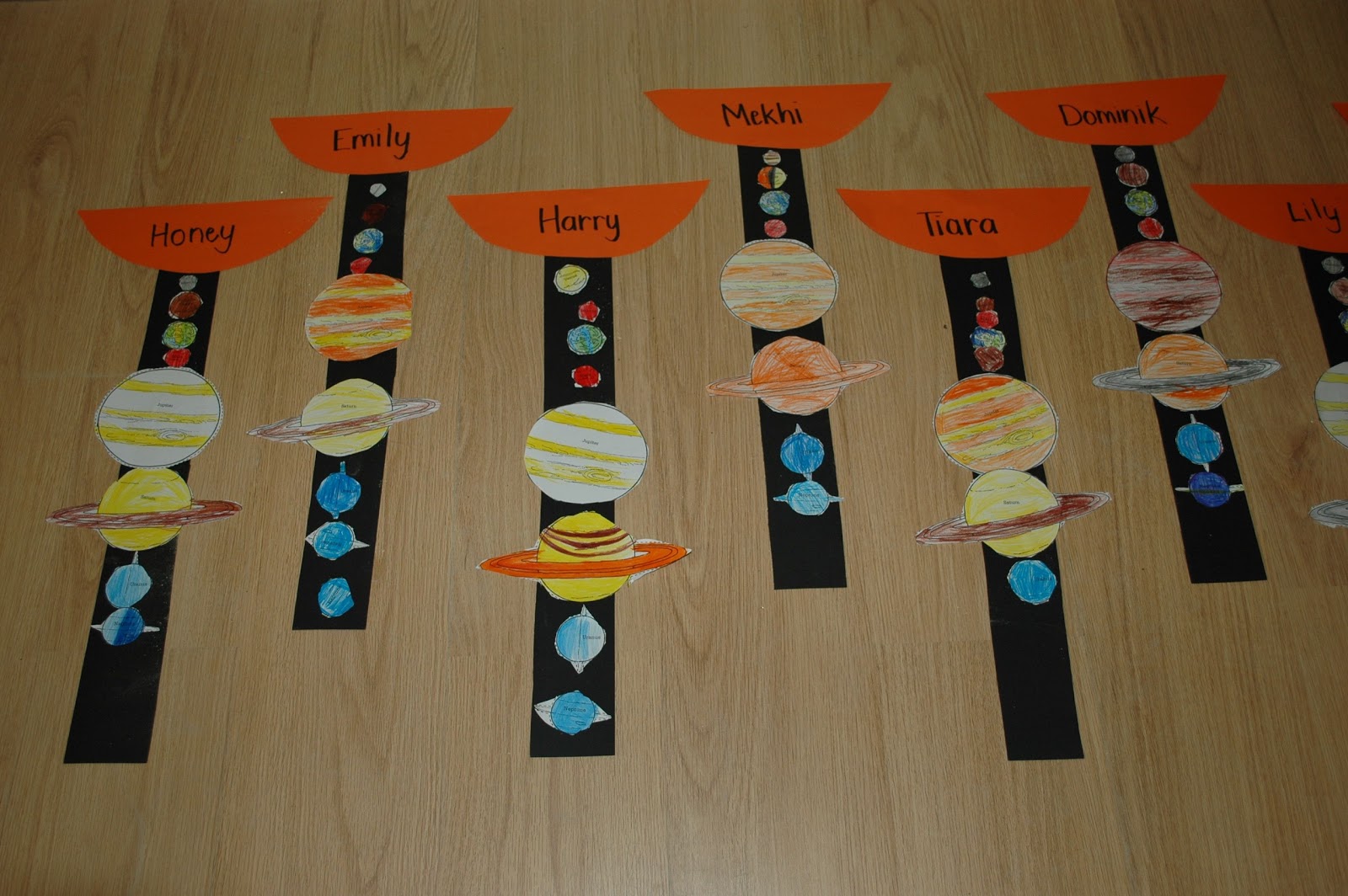
  6. There was less writing (although we wrote plenty - more than for the whole other three weeks put together!) and more art. These children LOVED their art. Check out some of these amazing solar systems they created.
    And some of the wall hangings:

  7. We went outside to create our solar system rather than drew it on the carpet. (Don't get me wrong: using chalk on the carpet is an amazing use of a very under-utilised space and we did loads of carpet drawing in this particular class BUT it was a sunny day so we went outside. Where better to pretend to be the sun than out in the sunshine?)
  8. Our leadership team bought into our explorations and often popped into the classroom to see which planet we were visiting. The children LOVED sharing their learning and showing off how much they'd learnt. (I loved watching them share their learning and showing off how much they'd learnt EVEN more than they enjoyed doing it.)
  9. We were able to share our learning with the other junior primary classes who all came to see our space journals, solar system hats, solar system wall hangings and art during one big exposition on the final day. Boy were we proud!
So, whilst it felt a little like I was cheating (because I was able to recycle a bunch of my resources and planning) my second space unit was really quite different.  I'm really looking forward to the opportunity to teach an older group about some space related topic. It's such a fun topic!

How do you teach about the solar system and space?

*I only use my tablet at school and am very careful around which photos remain accessible in this way.

Wednesday, 14 November 2012

Shoot for the stars...

Did you know that Uranus and Neptune are blue - in part - because of cow fart (methane) gas? No, neither did I until I discovered it with my class of 5 and 6 year olds a couple of weeks ago. It's amazing what you can learn with kids leading the adventure!

The other thing I didn't know about space until just a few weeks before that particular life changing discovery is that space (in the blue fart gas giants sense) doesn't feature in the ACARA  content descriptors until Year 3 and then again in Year 5. And so what does an intrepid space explorer do?

Well...After a bit of hyperventilation and a good swig of a lovely Clare Valley shiraz I decided that I would use space as a carrier for the 'Science as a Human Endeavour' and 'Science Inquiry Skills' strands. And in case you were wondering, this meant working towards these descriptors:
Science as a Human Endeavour
Nature and development of science: Science involves exploring and observing the world using the senses 
Science Inquiry Skills
Questioning and predicting: Respond to questions about familiar objects and events
Planning and conducting: Explore and make observations by using the senses
Processing and analysing data and information: Engage in discussions about observations and use methods such as drawing to represent ideas
Communicating: Share observations and ideas
My unit plan grew around these goals. The topic could have been gyprock or giraffe mating habits but... Well... I don't know much about the first and, to be honest, even less about the second, so space  seemed like a pretty safe option. 

I collected a whole pile of books (yes, the old school style ones with pages that can - and do - rip), some charts, some posters, a load of youtube clips, some models, some blow up globes, a lot of space stickers, a lovely quilted wall hanging featuring photos of space, my very special hand painted space shoes (they're amazing - go check out the artist's blog entry about them ) and set them out in front of the class and asked what they  already knew about space.
"Space holds up the moon!"
"There are asteroids in space, but mainly in earth."
"The sun has grey spots on it where it goes out until someone lights it again."
"There are planets on earth and the sun is in space."
"The sun goes down into the ocean at night." 
You get the idea. Following this we worked with some Grade 5 and 6 students to explore the books and charts before deciding, as a class, that we wanted to explore the space around earth - which I expanded to mean the solar system. We decided on some questions we wanted to answer about each planet and 10, 9, 8, 7, 6, 5, 4, 3, 2, 1! Blast off! We became space explorers.

As you can imagine it's a little hard to use your senses to explore space in a particular meaningful way and so I had to get a little creative. We held 'moon' rocks, and tried to land on a gas giant by jumping into the air in the playground. We compared the number of moons of each planet. We all span around the sun to understand day and night and drew great big orbit rings on the carpet to follow to understand why the further away from the sun the longer the orbit takes.  We learnt that some planets' days are longer than than their years - and how that related to our spinning and orbiting.


We created a journal of our explorations. Each day we visited a new planet - we knew the way because we learnt a 'cool' rap early in our exploration - and created a page for our journals. Each child chose what to include in their own journal and I helped with vocabulary and spelling.  (The literacy component of the whole thing was quite astounding - I was stunned at the writing achievements.) We ordered planets and we made a space display of our favourite facts. We sang, we danced and generally lived it up as space explorers.


Did we meet the goals though? Did we explore and observe with our senses? Definitely (even our sense of smell was involved once we learnt about Uranus and Neptune)! Did we respond to questions about familiar objects and events? Not only did we respond but we posed questions. Did we plan and conduct inquiry? Yes, with all of our senses. Did we discuss our observations and represent ideas? All day! (I think I owe some parents an apology for their children's latest obsession!)  Did we share ideas? Um... yes. Yes we did.

At the end of the day the children proudly took home a completed Space Exploration Journal and a whole range of science experiences. I probably learnt almost as much about space as they did but more importantly I learnt valuable lessons about teaching Science as a Human Endeavour and Science Inquiry Skills and about myself as a teacher. Onwards and upwards... Shoot for the stars and all that jazz.

Did I mention how much fun we had?