Showing posts with label Standard 6. Show all posts

Sunday, 12 June 2016

My First GoAnimate Video

For one of my M.Ed topics I had to create a video that tells the story of the role of ICT in contemporary education.  Considering the time that went into this, I thought I'd share it here as well.


I've already had it pointed out that even in this, an assignment about ICT, I've managed to bring in my strong views around social justice. My answer to that is that the story of ICT in education isn't complete without it being mentioned.  I could create a video on just that.

I can't say that it was my favourite assignment ever, but I did get to fool around on GoAnimate for the first time (and learnt LOTS) so I can't really complain. If you've never had a look at it, I highly recommend it. The biggest downside is that it's a paid service so it's not super accessible for use with students. On the upside, it's quite intuitive and easy to achieve a reasonable looking result.  And again, whilst I didn't enjoy the assignment, I will admit that the thinking involved in synthesising a story was an effective way of pulling together the semester's learning.  I'm not sure that primary school aged children have the metacognitive capacities to pull something like this off, but perhaps I'm wrong. Anyone have any experience?

I'm also curious to speak with someone who's used both GoAnimate and Powtoon, for a comparison. I've never found Powtoon particularly easy to use so haven't ever persisted with it. Perhaps now that I've achieved a degree of success with GoAnimate I might find Powtoon more intuitive?

Can I also share that two out of my four topics for this semester are now FINISHED? (As in, no more classes, no more books, no more teachers' dirty looks... Ooops, they come from me when I realise we've still got an hour to go and I'm already so tired I could spit!) Actually, what I mean is that we've finished our classes and I've handed in all of the assignments. What a relief!

This is a tough post to relate to the Australian Professional Standards for Teachers because it demonstrates a high level of 'meta-reflection' on standards 1 through 4 & 7, but it's really about MY learning which is standard 6. *sigh* I'm curious to know how all y'all would link it? For now I'm going to relate it to everything other than standard 5, because it's the weekend and time to live it up a lil'!
Standard 1 Know the students and how they learn
Standard 2 Know the content and how to teach it
Standard 3 Plan for and implement effective teaching and learning
Standard 4 Create and maintain supportive and safe learning environments
Standard 6 Engage in professional learning and improve practice
Standard 7 Engage professionally with colleagues, parents/carers and the community

Friday, 3 June 2016

Everything in Moderation

Creative Commons License
Post PD Reflection by Markeeta Roe is licensed under a
Creative Commons Attribution-NonCommercial 4.0 International License.
Based on a work found here.
Our professional development day just ended. 17 minute ago. In fact, I'm actually still at the venue. It has been such a big day that I'm torn between the exhaustion of this morning and the natural high of meaningful learning.

Today we were moderating maths tasks with teachers of the same grade level from other schools. Theoretically we were meant to provide three portfolios of 6-8 work samples; one portfolio at standard, one below and one above. (I say theoretically because... Life. You know? I pulled together 6 samples, but they were all from the same unit of learning because I've only been with this class for 9 teaching days!) We swapped portfolios around our table and used the Australian Curriculum achievement standards as our moderation guide.

These kind of events secretly excite me because I love the opportunity to see the learning experiences other teachers plan/use so that I can borrow their ideas.
Upon sharing our thinking, it was re-affirming to learn that as a group (of year 7 teachers and some guest teachers from our feeder high school) we were invariably consistent in our assessments. I have been 'accused', in the past, by another year 7 teacher, of being an overly hard marker so to have my positioned echoed by a large group of others was quite a relief. 

The process we used was, at the same time, incredibly simple and mind bogglingly challenging.  Simple in the sense that the initial question is: does this student meet this standard? Challenging in the sense that assessing the individual work samples as a holistic body of evidence against the achievement standard requires a fair degree of mental gymnastics. 

After/while looking at a portfolio we were encouraged to answer particular questions:
  1. Initial thoughts on the evidence provided in the work sample/s.
  2. What evidence in the work sample/s aligns with the standard? How? (Be specific.)
  3. What are the gaps in the evidence? What further evidence might be required to demonstrate achievement at the standard? (Be specific.)
  4. How might the assessment be modified to better reflect the standard? (This might apply to some, non or all of the tasks.)
These responses then formed part of the feedback each teacher received about their portfolios. My portfolio was deemed as not being a broad representation of the whole curriculum - which wasn't surprising. I received positive feedback about the tasks and some suggestions about ways to improve. It was fantastic! I also learnt about a bunch of resources and a new app from Justine Nelson, one of the awesome teachers on my table. Justine and I are also planning to share some other resources and ideas. That, in and of itself, makes today worthwhile. Thanks Justine!

The other part of today that our year level group found particularly useful was spending time with the team from our feeder high school. We worked with them to moderate some year 8 tasks, and then collaborated on extending the example tasks. The discussions around the differences between teaching and learning in primary and secondary schools were powerful if not a little frustrating. Each question lead to another three questions. We all wanted to keep going; talking to the other side (so to speak) isn't an opportunity we get very often.

The final (cute) little tip I'm taking from today are two little sticky note exit slip acronyms: WWW (what worked well) and EBI (even better if). Simple but I think they'd work well with my current kiddos.

I also need to give a shout out to Cheryl Josephs, who was also at the session today. She has known me since my second or third day as a teacher and has become a wonderful friend and trusted colleague. We don't often cross paths professionally anymore so it was a real pleasure to see her. She is one of my most committed blog readers so... Thanks Cheryl! It was wonderful to see you.

This relates to the following Australian Professional Standards for Teachers:
Standard 5 Assess, provide feedback and report on student learning
Standard 6 Engage in professional learing 
Standard 7 Engage professionally with colleagues, parents/carers and the community


Wednesday, 11 May 2016

I'll be the judge of that...

A photo posted by Markeeta Roe-Phillips (@markeetarp) on

Last night I made my debut as a debating adjudicator for Debating SA. Wow! My head is still spinning. I learnt SO much about debating, about giving feedback and about myself.

 I adjudicated three debates: a year 6/7 debate 'that single sex schools are the best', a year 9 debate 'that traffic fines should be based on income' and a year 8 debate 'that there should be a sugar tax'.   The students' debating experience level ranged from a couple of years to sharing the debut spotlight with me. Without exception, I was impressed by them. Some presented with the clear advantage of past coaching, others were obviously green but equally obviously determined and committed to learn. Some showed a sangfroid well beyond their years, others pushed through the nerves of their first truly public speaking engagement.  What a group!

 The challenges of the evening for me were many and varied. Our first debate got off to a late start because of some missing equipment and forms. Had I  - or any of the debaters - been more experienced this would have been noticed and resolved earlier. Meh. We coped.

The actual adjudication process is both straight forward and quite complex: lots of balls to juggle, with each new speaker adding another type and size ball. Taking careful note of each speaker's arguments (and rebuttals), presentation and debate structure is vital, but actually not very easy. People, and in particular children, speak really fast! Pulling out the salient points and matching them with the criteria against which they're being judged is not dissimilar to assessing students' oral presentations in the classroom in many ways. Fortunately Debating SA provides a comprehensive rubric against which to score each speaker which certainly helped.

Matching each speaker's rebuttals off against their opponent's arguments is, I'm hoping, something that gets easier (and faster) with time. One of the other areas I predicted would be challenging was recognising (and naming) the difference fallacies of argument and rebuttal. I've never debated so whilst some of these fallacies are part of our everyday vernacular many are new to me. Being the nerd I am, and knowing how I learn, I created online flashcards.


Please feel free to use my Quizlet 'study sets' with your students if debating and flashcards are your/their kinda thing..

I found that I was fine at recognising and naming the fallacies in my notes, but struggled to use that knowledge in my feedback to the students. I need to work on that.  Having said that, I received feedback from a number of parents that the feedback I gave was balanced and constructive. I used a template to record my feedback before I gave it so that I could make sure I used a sandwich approach: positive, something really specific to work on, positive. I also made sure, over the team, to include a good range of argument, rebuttal, presentation, structure feedback.  And I made special efforts to build up the students who stood up, had a bit of a freak out and then ploughed on. The second they realised that I was congratulating them and wasn't going to reprimand them their whole body language changed.  It was a very real reminder of the value of personal, specific, timely feedback. #highlight

I've got some way before I'll be confident at this, but that's OK. I'm learning, developing and growing. And having fun! That's the way I want my students to feel about learning, so I'm taking careful note.

This relates to the following Australian Professional Standards for Teachers:
Standard 6 Engage in professional learning

Monday, 9 May 2016

More than Just Cyber Safety: Tackling the Social and Ethical Protocols of the ICT General Capability

The material is licensed by ACARA under CC BY 4.0.
I need to start this post with a quick introduction to the Australian curriculum general capabilities for my readers who aren't based in Australia or are otherwise unfamiliar with - what many Australian teachers call them - the gen caps.  Please think of them as one of the ways our curriculum describes the knowledge, skills, behaviours and dispositions that will enable our young people to "live and work successfully in the twenty-first century" (ACARA, 2015). There are seven general capabilities:

  • Literacy
  • Numeracy
  • Information and communication technology (ICT) capability
  • Creative and critical thinking
  • Personal and social capability
  • Ethical understanding.
  • Intercultural understanding
The general capabilities are, perhaps, some of the more ignored parts of the AC.  Whilst the curriculum documents do, in fact, provide learning continuum and explicit cross-curricular links some of the gen caps tend to be left in the too hard basket, or ignored all together.   Clearly these options aren't acceptable and regardless of what we think of the AC, it is our mandated curriculum so we have a responsibility to teach it ALL. 

Wow, that started to get a little preachie-preachie didn't it? Sorry about that! I get a little fired up because it frustrates me when I see teachers choosing to ignore one or more of the gen caps because they, personally, aren't confident or competent with the concepts.  Step up people, or step out.

And again! #sorrynotsorry
The material is licensed by ACARA under CC BY 4.0.
Back to the actual point of this post...

The first professional development session I attended in the last school holidays was run by Teacher Technologies and focussed on parts of the ICT general capability of the Australian Curriculum, specifically the social and ethical protocols and practices.

There were a couple of recurring themes throughout the day. One was the idea that we, as teachers, have a responsibility to model social and ethical behavioural choices for our students. (And not just when using ICT I might add!) This isn't a new idea but it's certainly an important one to consider. Think about the example we set when we - and I'm not saying that I, or you, do or don't do this - download an YouTube clip to use in class. Sure, we can justify it under the 'educational use' umbrella but do our students know that?  Do we explicitly explain to them what we're doing? Do our students know that they can't do the same thing? How would they know? And if, after we've downloaded a clip, we store it on our hard drive for next year is it still OK?

Another example are the images that we put in our presentations, or assignment sheets. I don't know about you, but I take great pleasure in finding the perfect image and will openly admit that I don't always do the right thing. And so the example I set is to use whatever image I like regardless of ownership. I am slowly getting better though. Actually, you know how ex-smokers are the worst kind of non-smokers in terms of telling people to not do it? (And with good reason! High five if you're an ex-smoker!) Well, I'm that person in my  house now, with creative commons images: I'm pretty sure my husband is going to take away my internet access if I ever again look at something he's done with an arched eyebrow and comment "that doesn't look like a creative commons image to me".

Yesterday one of my own children approached me with a question about referencing a podcast using the Harvard system. After I quit shaking (because I'm an APA girl through and through) I pointed him in the direction of some websites that I've found helpful in attributing my sources recently.  And it dawned on me what had just happened. My 14 year old, who listens to The Naked Scientists podcast like I listened to the Top 40 at his age, was using an idea he'd heard in a podcast to help build his argument in an essay on parallel universes, black holes, space. He knew he needed to attribute those ideas appropriately. Yay! Somewhere along the line, whether at home or at school, this kiddo got it! He understands intellectual property.  I did, of course, wonder whether he'd picked it up from good modelling (ahem!) or if it had beeen explicitly taught, which brings me to the other recurring theme.

Whilst we must model social and ethical protocols and behaviours when using ICT it is just as important that we explicitly teach them. It would be lovely for young people to pick up on why it's not a good idea to click on every *enter now* button through osmosis, but it's not overly likely. As a teacher, I use a range of strategies to keep any personal information I keep (digitally)about my students secure. (And securely destroy the files when appropriate.) This isn't something I can model to my students though, it's the kind of thing that needs to be explicitly taught in developmentally appropriate ways right across the primary and secondary years of schooling. The ICT gen cap learning continuum is very detailed about when and what students need to learn.

I could write about the importance and value of this component of this gen cap all day because it's something that is of increasing importance to everyone. As you can imagine, I was tweeting all day. I'm sharing Selena Woodward's Storify today. Enjoy. (As you scroll through, you'll notice that we were a bit spoilt for morning tea! I think there were about 10 of us there...)


This relates to the following Australian Professional Standards for Teachers...

Standard 2 Know the content and how to teach it
Standard 4 Create and maintain supportive and safe learning environments
Standard 6 Engage in professional learning
Standard 7 Engage professionally with colleagues, parents/carers and the community


ACARA. (2015). General capabilities: introduction. Retrieved from http://www.australiancurriculum.edu.au/generalcapabilities/overview/introduction

Friday, 6 May 2016

Planning

Anyone who's known me over the last couple of year has probably noticed my habit of spending at least a couple of days of each school holidays in professional development sessions. So, whilst I'm not actually in a classroom this year I still found myself booking in a couple of days' training in the recent holidays. (Because studying for a M.Ed full time isn't professional development? Yeah, I noticed that bit of flawed logic too.)

The first PD session of the holidays was entitled "More than Just Cyber Safety: Tackling the Social and Ethical Protocols of the ICT General Capability". Great day, and I will blog about it (update: you can read about it here). First, I want to talk about the other one, which was a Reflect Growth session focussed on planning, because I am a self-confessed planning nerd! I'm sure I've said it before but I'll say it again: I love planning!

We started the day building with Selena Woodward very ably helping us to build a shared understanding of the need for long (year), medium (unit) and short (lesson) term plans. We pulled apart a battery of questions we can - and probably should - be asking ourselves during our planning processes and tried to work out where in the process they fit. It was fascinating to hear different educators describe how they use the questions at different stages of planning.

Of course, it wasn't long before -  as things do in Australia whenever a group of educators converges - the discussion moved to how the Australian Curriculum (AC) has had an impact.   My opinion (and take this with a pinch of salt because whilst I trained with the former curriculum, I've only ever taught with the AC) is that without the need to think about content our attention can be where it needs to be: on pedagogy. (Which means I like the AC.)  The Twitter back channel was alive at this point talking about the need for planning to be responsive to our students' needs. Oh boy, was I excited to hear someone say that! I worry sometimes when I hear educators talk about their plans as though they are set in stone... What if the kiddos have different needs than the plans cover?

The rest of the day was divided into long, medium and short term planning discussions. (And a few mini learning activities designed to jog some thinking about new teaching strategies - thank you Selena!) Each discussion started with a speaker from a 'different walk of life' (me for medium term!) to encourage divergent thinking.

Our first speaker was Rebecca Wells who startled me into thinking about the role leadership can, and should, play in my long term planning. She suggested that a leadership team has a responsibility to support innovative planning and teaching with appropriate resources, and with connections to community. I LOVE this idea.  My mind went off on a little tangent here thinking about different ways of having ongoing meaningful community engagement in classroom. (Stay tuned because I feel a post about that bubbling away beneath the surface.)

My talk started... No... I'm not going to describe it all. You can watch the video if you are particularly keen, but suffice to say that I described planning in terms of maps and positioned medium term planning that way.  I didn't share anything that was likely to start off any educational revolutions but rather that medium term planning is where the magic happens (for me). It's where I get to build a structure into which I can ensure I meet all of the (sometimes conflicting) needs of my individual students, the curriculum and whoever is pulling on my at that point.


Markeeta Roe Phillips on Planning - Like a Map :) from Selena Woodward on Vimeo.

Our last, but by no means least, speaker was Lynda Rivett who shared a plethora of personal experience using TfEL tools in creative ways. It was a good prompt to me: I know that TfEL has a mountain of resources sitting there waiting to be used but I tend to stick to the ones I'm most familiar with and have on hand. I need to block out a few hours in my calendar and really delve into what's available.  Why reinvent the wheel when TfEL already has a whole tyre yard full of them waiting to be used?

I have so many powerful 'takeaways' from this day:
  •  I'm reminded of the power in good planning:
    • Power to effect strong learning; 
    • Power for cross-curricular syntegration; 
    • Power for collegiate sharing; 
    • Power in achieving balance; 
    • Power because I love the art/science of it!  
  • I sound like a small child when I speak; I think I need to work on my vocal patterns.
  • There is no right way to plan, but there are lots of dodgy ways. I'm comfortable with elements of my planning tools, but think I should use this time out of the classroom to hone and tighten them.
All of this discussion culminated in Selena throwing down Reflect Growth's next Metateacher Challenge which is, this term, a question: Which part of the planning process has the greatest impact on a student's growth?  I already have a fairly strong opinion but am keen to hear other views. Please share yours in the comments. 

On a side note: if you're on Twitter, I highly recommend you check out #reflectgrowth for an interesting stream of thoughts, ideas and sharing from educators interested in developing and improving their practice.  I'm a bit of a mad tweeter on days like this one, so have created a Storify of just some of the tweets from our session. 


This relates to the following Australian Professional Standards for Teachers...
Standard 1 Know the students and how they learn
Standard 2 Know the content and how to teach it
Standard 3 Plan for and implement effective teaching and learning
Standard 6 Engage in professional learning
Standard 7 Engage professionally with colleagues, parents/carers and the community

Friday, 11 March 2016

While We Teach, We Learn

Created on recite.com
How often have you heard the phrase "the best way to really learn something is to teach it to someone else" or "to really check your understanding of something try teaching it to someone"?   An article that I've just read for one of my M.Ed topics looks at this very idea and unpacks which component of teaching is actually the helpful one.  The article suggests that that whilst preparing to teach something can be helpful in short term learning, it's the act of teaching (explaining, defending and discussing) that leads to long term learning (Fiorello & Mayer 2014).  Which makes sense right? If we know that we're not going to have to actually deliver anything on what we're learning then our engagement levels and motivation will be somewhat lower than if we're going to have other people looking to us for the explanation.

It's such a simple idea isn't it? And I don't know about you but I can really relate to it.

Let me share a little tale... (Settle in because as you can probably correctly predict: I'll take a little while to get to my point.)

I consider myself to be a reasonably literate person. I came through primary school, however, during an era when teaching grammar was not particularly fashionable. Verbs? Articles? Parsing sentences? That was for chumps - we had whole language! (Or maybe we didn't, I could read and write very early so maybe the other kids were doing that while I was allowed to skip it?) I eventually learnt about grammar through studying languages other than English later on. (For which I will be eternally grateful because there are thousands of Australians around my age who still don't know why ending that last sentence with 'on' leaves a slightly acrid taste in my mouth.)

Our current curriculum requires students to understand much more about grammar than I was ever taught, and from the very beginning.  Even in year one students are expected to:
Explore differences in words that represent people, places and things (nouns, including pronouns), happenings and states (verbs), qualities (adjectives) and details such as when, where and how (adverbs) ACELA1452
Investigating & categorising
 types of adverbs
So the other day as I was preparing to teach a lesson about adverbs I realised that whilst I could explain, with a reasonable degree of confidence, a broad definition of an adverb (and the fact that in English that can be placed before AND after verbs) I couldn't really go a great deal further. Eeeeeek! I pulled out my books, swiped frantically on my iPad and pretty quickly learnt more about adverbs than I thought humanly possible for late on a Sunday afternoon.  I designed a learning flow and was actually a bit excited to share it.

The following morning my new learning was settling in my mind like slightly set concrete... I was a bit worried that it wasn't quite strong enough to hold up any questions that might land on it but, of course - and you knew this was going to be the case, because you know that I like happy endings - as I delivered the lesson the concrete set harder and harder. And today, nearly a week later,  I feel confident in my new understanding of adverbs.

What does this mean for me as a leader of learning? How can I incorporate more opportunities for my students to use this strategy meaningfully? How do you use it in your learning environments?


Fiorella L, Mayer RE. (2014). Role of expectations and explanations in learning by teaching. Contemporary Educational Pyschology2014;39(20):75-85
As I was reading the article for the first time, I had to chuckle.  I can say that whilst I do genuinely enjoy my uni reading (y'all already knew I was a nerd!) and always take it very seriously, this particular article - without a shadow of a doubt - was getting more attention because it's the one assigned to me to 'teach' the rest of my group. Talk about life imitating art... Or science... Or research... Or whatever we're calling this.  


This relates to the following Australian Professional Standards for Teachers...
Standard 1 Know students and how they learn
Standard 2 Know the content and how to teach it
Standard 3 Plan for and implement effective teaching and learning
Standard 6 Engage in professional learning


Sunday, 6 March 2016

A Gift

It's no great secret that I'm a bit of a learning junkie so it won't come as a surprise to anyone that I've been a wee bit excited about returning to study this year.   I'm braving the waves of postgrad study; I'm enrolled in a Master of Education (specifically an M.Ed in Cognitive Psychology and Educational Practice) at Flinders University. Officially classes started last week, but I jump started things by taking an intensive summer school subject back in January.  

It's that subject that I want to talk about today. That subject was (and still is!) called Conceptions of Giftedness, Intelligence and Creativity. A bit of a mouthful right? Basically, whilst the intelligence and creativity parts of the title are clearly important, the subject really focusses on working out what giftedness actually is so that we, as professionals, can advocate for the gifted kids in our classes, schools and communities. 

It's a bit of a touchy area for me because my two children are gifted. 

Until a few years ago, I raised them as a single parent, just the three of us. My whole experience of parenting was with gifted children: meeting developmental milestones scarily early; dealing with their incessant need for challenge and learning; advocating for their special (yes, special) needs; supporting them in the areas that lagged behind their intellectual and creative development; conversations about anything from nuclear fusion to the medieval English serfs' use of non-arable land; the need to manage social activism from one son who wants to save the world (whilst happily ignoring problems closer to at home). This was my norm and, as such, I never once considered that it might be different to any one else.  

Then I married a man with four sons of his own.  I discovered, very quickly, that there is a huge difference. I could write a thesis on the ways our two groups of boys are different. Some of the differences are simply down to different families of origin but most are not. Most stem from the differences in the way the boys experience, perceive and interpret the world. There's nothing inherently superior in either way; in fact there are 6 different ways because there are 6 different kids. There are undeniable differences though.

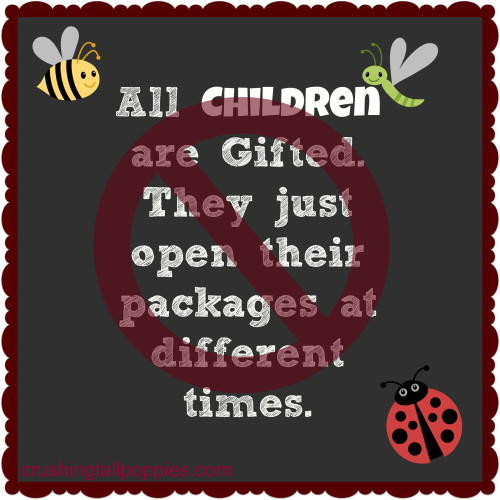
This blog post, over at
Crushingtallpoppies.com,
shares my frustration with this myth.
I'm sharing these details of my life because one of our assignments requires us to rebut and then positively reframe myths about giftedness. And... As a parent of gifted children I'm finding it really hard. The first myth we addressed was that all children are gifted. *internal scream* No. They're not.  All children are unique, but they are NOT all gifted. I witness this truth every time I sit at the dinner table with our combined tribe and hear the disparity in conversations. I see it every time I look at the learning tasks of my 14yo gifted son compared to my 14yo stepson. I feel it as I see the frustration in my son at the way his stepbrothers skate over the surface of something he wants to share deeply. I know it in my bones as a mother. Right there, that's where I'm having trouble with this. I'm struggling to step back and be a student rather than mama bear.

Anyone who has seen me with my other kids - the ones who call me Mrs RP - knows that when advocating for them I'm often in full mama bear mode. With these kids I guess it's a bit different though. As Rita Pierson eloquently describes it, I'm acting as their champion. This is different to being mama bear in many ways, but overlaps in others.  Is this why I'm struggling to make the distinction between mama bear and student? The overlap? I don't know but I have a sneaking suspicion that it's something I'll struggle with in all of my studies about giftedness because it has been such a big part of my role as a parent. 

I didn't expect to be so emotionally challenged by my first subject but I can tell you that it has pushed me further and deeper into my readings than I expected so it's probably a good thing. Some might even say it's a gift. Ha!


This relates to the following Australian Professional Standards for Teachers...
Standard 6 Engage in professional learning
Standard 7 Engage professionally with colleagues, parents/carers and the community


Thursday, 25 February 2016

Single Point Rubric?

Let's talk about single point rubrics. Maybe I've been hiding under a rock for the past three and a half years but last night was the first time I'd ever heard those words uttered! I was at a Teacher Solutions PD session about the Digital Technologies learning area of the Australian Curriculum and single point rubrics were presented in with a slew of other information; I'm pretty sure the words "my head hurts" escaped my lips on more than one occasion more than once.  So, you guessed it: I had to do a little research on my own.  (I'm nothing if not predictable reliable.)

Long story short: it's a single set of criteria with room to record notes/evidence for performance above and below standard. Am I showing my age when I say "and here's one I prepared earlier"?

There are about as many formats as there are users.
I chose this one because it's familiar.
I struggled to get my head around the idea during the PD session for a couple of reasons. The first being that as a concept it's pretty simple, and glaringly familiar. I was confused by this. The example we were shown had about 30 criteria though (the entire Digital Technologies learning area) so I was puzzled: how was that remotely practical? Once the penny dropped that - in practice - these rubrics need only have the same criteria as any other rubric, aside from feeling a little foolish, I was intrigued by the potential.  Next I wondered how these were significantly different from the success criteria that I already use. (I post our success criteria on the wall (as you can see here) or task sheets.) In a nutshell: they're not! Well, sort of. They are in a different format with an assessment focus but using the same ideas and words.  Single point rubrics use these success criteria as the basis for identifying and recording evidence and feedback.

It was from this point that my inquiry began. The most interesting article I found was from the University of Nebraska that discusses the power of these rubrics as formative assessment and as a tool for responsible self-assessment. This resonated deeply with me because of my views on the importance of the role of 'self' in assessment and development.   It also reminded me of the anecdote shared doing the PD session: one teacher uses a red pen to write on these rubrics, the student uses a blue pen and their peers use a black pen. I'd been impressed by this story at the time but on reflection saw the potential as even more exciting: this opens the potential for a documented learning discussion. (I do wonder though whether there might be a digital option that works better? Perhaps a Google doc?)

Ultimately this is another tool to add to my repertoire. I can see how easily it could enhance my current practice: after building student capacity to identify success criteria - based on the curriculum achievement standards or whatever else we're working toward - these are publicly posted and used to create a single point rubric. Over time student capacity is built to use the rubric as a form of formative self assessment and peer assessment. In some ways it feels like a formalisation of what already happens.

Do you use single point rubrics? Any tips for success?

This relates to the following Australian Professional Standards for Teachers...
Standard 6 Engage in professional learning


Sunday, 21 February 2016

Lean Change

Yesterday, at the Reflect Growth meet up, we heard about the synergy between good teaching practice and a particular business model called Lean Change Management. The speaker (Selena Woodward) related that as she read about this model she couldn't help but see the similarities with what we, as teachers, do all day everyday.

My interest was piqued and so I've done a little digging.

Lean Change Management Cycle from Leanchange.org
This image uses slightly different language to Selena's presentation (build, measure, learn) but demonstrates the similarities beautifully.

Our 'meta' process, or the green cycle involves planning (options), then teaching (experiment) and then reflecting (insights) before the cycle continues.

The part that REALLY appeals to me is the yellow cycle. That, right there, is the everyday, moment by moment reality of teaching. We have a lesson plan, meticulously researched, considered and prepared (prepare) in hand and ready to go. The lesson is moving smoothly (introduce) until we notice that there is an undercurrent of social tension and we instantly decide that a different path needs to be taken (review). Within seconds a  new plan emerges in our mind (prepare) and we move into that stream (introduce) and so on. It is this ability to fluidly review and re-start the cycle that characterises quality teaching.  It is making snap decisions between staying 'on plan' or being responsive that creates successful teaching and learning relationships.
It is understanding that teaching follows this cycle widely and intimately that frees us to innovate our practices and meet the actual needs of our students.  In the end, that's what it's all about.

This business model comes from a field that relies on innovation. And for me, therein is the power of identifying this cycle in a field outside of education. It reminds me that what we do is not separate, or different, from the 'real world'. Our success as educators relies on being responsive and innovating.

This relates to the following Australian Professional Standards for Teachers...
Standard 6 Engage in professional learning

Saturday, 20 February 2016

Sharing in Isolation?

For all that teaching is a high social role, it is not without its fair share of isolation. Perhaps more than its fair share? We spend most of our working hours surrounded by the young people who inspire us to become teachers, which is as it should be. For many teachers these hours are bookended by solitary periods of planning and marking, and punctuated by mad dashes to the bathroom or photocopier; not much by way of meaningful adult interaction; not much time to share our practice and encourage each other's growth.

It's the lack of sharing and encouragement that, I think, is particularly troublesome.  I know a lot of teachers who shrug their shoulders and say 'it is what it is' at this point but, as you know by now, I'm not that kinda teacher.

This morning I spent a number of hours at a Reflect Growth meet up where one of the the goals is always to try to address this very issue.  Under the wise guidance of Selena Woodward (she'll laugh at that description) we talked quite broadly about our teaching practices and then had the pleasure of listening to Chantelle Morrison talk about the innovative and student-lead process she used to set up her classroom this year. Following this we spent some time individually reflecting on big picture goals we want to strive for this term and perhaps more importantly sharing those goals. I was quite humbled to sit next to Chantelle who shared with me that she wants to work on her use and understanding of anchor charts. She asked me about them because she remembered hearing me talk about them. It was reaffirming that my experience could be used to encourage someone else. (I'm not 100% convinced she was encouraged but let's just leave it there shall we?)
I wondered, at the time, if everyone else found the act of sharing our goals confronting? And why did I find it so? Last year I shared my goal of developing my understanding and skills using working walls, and with the sure knowledge that I was going to share my growth in a public presentation. The act of sharing meant that I felt compelled encouraged to work towards my goal and gave me a sense of accountability. And you know what? I loved it. What was different this morning? I don't know.
We eventually used a (new to me) web based tool called canvaniser to build a plan around our goals using some of the language of 'lean change'. And again, we had the option to share this plan as we made it or within our virtual Reflect Growth forum. The idea of sharing our goals is to garner support, share ideas and encourage each other.
Created using https://imgflip.com
Notice the common themes here? You got it: sharing and encouraging.  Whilst I've been really blessed to have worked with some amazing people with whom I've shared and offered/received a lot of encouragement there is nothing quite like the coming together of teachers with the explicit goal of doing it.  The ways of achieving this sort of network are endless and I encourage all teachers to seek out a group, a friend or even online network that works well for them.

I feel renewed - and considerably less isolated - after spending the morning sharing with other teachers.  (I wonder if I'd feel even more renewed if I'd taken advantage of the free massages from KindaKneady that were on offer this morning?)

(Incidentally: my goals are around sharing learning goals and working with students to develop success criteria and learning more about the pedagogies that make stations/carousels successful in a rigorous classroom. If you would be willing to talk with me about these things I'd LOVE to hear from you. If you live locally, I know a really great coffee shop...)

This relates to the following Australian Professional Standards for Teachers...
Standard 6 Engage in professional learning
Standard 7 Engage professionally with colleagues, parents/carers and the community

Saturday, 5 September 2015

QR Code Trail Update & Reflection

I'm super tardy in posting this update on my book week QR Code Trail (the original post is here). Sorry! All I can say is that during book week I found a whole pile of new YA novels that I wanted to read before releasing into the wild my classroom. I finally reached the point of being ready to read Divergent. (Gotta say that I'm loving it way more than the movie, but when do bookworms ever enjoy a movie more than the book.)

The codes went all the way around the school.
Parents had to visit many classrooms to find them.
Back to the topic at hand: here's the update.  We had a small but significant number of parents participate in the trail on the first day of book week.  Some others came back the next day to do it. (Yay!) Some of my kiddos met them, with their iPads, and acted as tour guides. Thank goodness they did! Not all parents had wi-fi, and some didn't have QR readers.   Our school internet connection decided to play hide and seek for most of the afternoon too which didn't really help.

However... The parents  enjoyed the experience. My kiddos were able to talk them through both the process and the literacy concepts that each video covers.  From what I could gather, this aspect of the trail was particularly appreciated. Pretty proud of the kiddos for stepping up like this. 

What did I learn from the process on the day?
In terms of the videos themselves: my learning journey continues. I need to improve the sound quality and reduce background noise. The best comments came from children who were guided through very specific - almost leading - questions rather than allowed to freely discuss the topic.  You're welcome to view the videos on the school's YouTube channel.  We've set them to 'no comments' but I'm keen to hear your feedback through this blog or via twitter (@markeetarp).
In terms of the logistics: iPads don't have the world's loudest speakers. I need to provide headphones, especially if it's windy (as it was). 
In terms of the 'entry form': people rarely carry pens these day so I needed to provide those (which meant my kiddos had to run back to the classroom to grab them). I think a better option would be to set up a google form but that would reduce the drama of pulling a winner out of the hat when we choose the winner of the book voucher (to entice participation). Having said that, it would certainly give us another opportunity to demonstrate another of the e-tools we use in the classroom (random name selector).

I'm inspired to build on this experience in the classroom - both the videos and the QR codes.

This relates to the following Australian Professional Standards for Teachers...
Standard 3 Plan for and implement effective teaching and learning
Standard 4 Create and maintain supportive and safe learning environments
Standard 6 Professional engagement
Standard 7 Engage professionally with colleagues, parents/carers and the community


Sunday, 23 August 2015

QR Code Trail for Book Week

Tomorrow signals the start of Book Week 2015.  Our school has a whole pile of fun events planned - including a fancy dress parade on Thursday (eek!) - including a reading themed  'open house' tomorrow afternoon. We've turned our timetables upside down and are running our literacy blocks after lunch instead of before recess so that parents, grandparents, neighbours, family friends and anyone else interested, can  come and take a peek at the awesome literacy learning we've got going on!

We'll see how it goes. Last year we tried a literacy themed open house one morning and had very few visitors. One of the ways we're hoping to entice more people in this year is with the chance to win a book voucher. We're just that nice! Joking. We totally are that nice, but not made of money so to be in the running to win the book voucher people will need to answer a series of questions based on videos that they'll access using QR codes that will be placed around the school.

Fun idea huh?  I thought so. (Of course I did. I helped come up with it!) I even volunteered to make the trail. It'll be fun I said. It'll be a great learning opportunity I said. It'll be easy I said.

And it has been fun. It has a HUGE learning experience. It has been... Well... OK, it hasn't been easy at all.

I booked a reliever for a half day to get the filming done. And then a meeting was booked, so I lost most of my filming time. Not a huge problem, but it took a little longer than I expected and I was left with less than 2 lessons to film. A lot of the filming I needed to do was in my building, which meant I was right there to witness my kiddos' awful behaviour. Again, not a huge problem, but dealing with it ate up more of my time. A 'social media' related issue broke while I was in the building and I ended up sitting in on the initial discussions with some of the students involved. I'm glad I was there for it, but again... Time was ticking away.  I am so grateful to the teachers who lent me students for filming, rearranged their schedules to let me film and particularly to Ms Sally Slattery who filmed the junior primary students for me.

iMovie is not a daily use programme for me. In fact I'm pretty inexperienced. The movies are OK, but I can't see Spielberg calling anytime soon. I'm so pleased I pushed through and feel much more confident now.  I can't wait to do more movie making with the kiddos now - usually I feel really out of my depth but think I might be able to offer more meaningful advice now.

YouTube is driving me mad. To be fair, it's not YouTube's fault.  The internet speed at my house has been heinously slow on weekends ever since Netflix hit Australia. In the end I packed up my computer and head over to a friend's house with a bottle of red wine and my best puppy dog face. He works at home for HP so usually has a super quick connection. Even there it took a couple of hours! Not happy!!

Next up are the QR codes. No major problems there. Although when I printed the codes and questions I discovered that my son had left some delightful green paper in the tray and we're almost out of black ink. Of course we are. Nevermind. I'll either use these or reprint in the morning at school.  If only my laminator hadn't gone missing during the last school holidays... Hmmmm.

This whole process is gambling on participants having QR code readers on their devices. We've invited them to come to the school library before starting the trail and my kiddos will help them download one if necessary.  Keep your fingers crossed that the school internet is playing nicely! (It hasn't been for the last couple of days.)

I'll update tomorrow when I get some feedback from participants.  I so hope it works, but am pleased to have done what I have even if not a single soul participates because I've learnt a lot.

This relates to the following Australian Professional Standards for Teachers...
Standard 3 Plan for and implement effective teaching and learning
Standard 4 Create and maintain supportive and safe learning environments
Standard 6 Professional engagement
Standard 7 Engage professionally with colleagues, parents/carers and the community


Thursday, 16 July 2015

Teachmeet Love

One of the ways I like to learn about what's going on in other teachers' heads/rooms/offices is through attending teachmeets.
Teachmeets have been around since 2006 and are a casual meeting of educators who want to learn from each other.  Originally starting in an Edinburgh pub (unsurprisingly) the gist was for people to share some idea, good practice, innovation or techno-tip in either  2 or 7 minutes. The idea spread and these days teachmeets are held all over the world in pubs, staff rooms, breakout rooms at conferences, and wherever teachers gather.  For more information you can try here, here, and here.
This week saw me present at a teachmeet for the second time ever. The first time I spoke about answergarden and padlet as collaborative classroom tools.  The range of other topics was inspiring. You can check it out Selena Woodward's storify from the live tweeting here:


This particular teachmeet had a theme (some so, some don't): wellbeing.  It's a hot topic at the moment isn't it?  I chose to speak about a particular strategy I use with my students to develop mindfulness. It is, at a very basic level, a guided mediation.  We 'go to the beach' and focus on all of our senses.  It has been a powerful tool for many of my kiddos both at school and home. So, it was an ideal concept to share. [AND I had my first play with haiku deck (following @tina_p's inspiration at the last teachmeet). You can check out my super basic presentation here. (It doesn't actually say anything so don't expect anything too exciting!)]

Anyway, here's the storify for this teachmeet.


If you ever have the chance to attend - or even better: share at - a teachmeet, GO FOR IT! I promise it's worth it. 

And: if you're in Adelaide why not follow @tmadelaide on Twitter or join the Facebook Teach Meet Adelaide Facebook group to hear all the details about the next event? 

This relates to the following Australian Professional Standards for Teachers...
Standard 6 Engage in professional learning
Standard 7 Engage professionally with colleagues, parents/carers and the community


Wednesday, 8 July 2015

Reflect Growth

One of our most basic human needs is belonging. It's not the most basic - that would be wi-fi these days - but it's right up there. Belonging to someone or something bigger than ourselves is a constant driver for (most) people. It's why we check Facebook umpteen times a day, it's why we join book clubs and it's why we buy cats! Cats aside, or maybe not, it's really about a need for community.

This year I've found myself part of a new online community. I know that there are hordes of people out there (assuredly not reading this blog) who claim that social networks and online communities are Bad. Yes, capital B Bad.  You know what I think?  I think they were wrong about video killing the radio star and they're wrong about this too.


I even did a little research on the topic and found that I'm not alone. In fact:
"Despite the opinion of some, real community and sense of belonging can be found and nurtured online through participation, collaboration, storytelling and exchange of information." 
May 16, 2015, Do Re Media
This year, I've found myself part of a new and exciting online community of educators called Reflect Growth.  We are are an online community of educators working together to share professional practices and co-create a piece of software.  I'll get to the software in a moment, because it's a bit exciting, but for me the delight has been in finding a community of (mostly local) teachers who share my goal of active professional growth and reflection. Meeting these educators, in person and online, has been refreshing and inspiring.  It's met some of my need for belonging to a community.

And a community it is. We share, amongst other things like coffee and cake,  inspirations, frustrations and goals. We challenge each other's thinking and explore ideas. We've been taking apart the AITSL Professional Standards for Teachers to work out what they really mean, and have hypothesised whether the introduction of them is the precursor of Ofsted style inspections like in the UK. We've talked about the TfEL framework and how it links with our understanding of effective teaching and learning. Pedagogy, padagogy, Blooms, Gardner... You name it, and we've been there. Even if only briefly.

It's been a very busy little community. Much more so than any I've been in before, which begs the question of why?  I have an inkling.  A couple actually.

  1. Strong and active foundational members
  2. A driving purpose

The couple who launched the Reflect Growth community are originally from the UK, but moved to Australia - presumably for the weather - a few years back. Since arriving, Selena has taken the education world of South Australia by storm and is well known as a mover and shaker. When she speaks, people listen. Her voice demands to be heard (which is actually doubly true when you consider her operatic training) and she put the call out for teachers to get involved with driving their own professional development.  The other half of this (actually very quietly spoken) duo is Matt. Full of ideas and technological know how he is a man with a mission.  Together these two are a force to be reckoned with! They hold us together as a community and, it seems, genuinely care.

I'll come back to the software I mentioned earlier. Still in the early stages of development the app is being designed to support teachers in driving their own professional development. It will help identify areas for growth and collect evidence to support it. Today, I've been privileged to spend some time playing with the prototype. I can't speak highly enough of it!

Next up for the community looks to be teacher challenges that will see us share our practice in an open setting. A version of a virtual classroom visit, sort of, with the opportunity for/expectation of feedback from other community members. Eeek! New ideas and feedback!  Can you see why I enjoy this community so much?

Come join our community at www.reflectgrowth.com! The more the merrier.

(Incidentally, you can check it out on Facebook during your umpteen checks here. Or Twitter here.)


This relates to the following Australian Professional Standards for Teachers...
Standard 6 Engage in professional learning
Standard 7 Engage professionally with colleagues, parents/carers and the community


Tuesday, 7 July 2015

Effective Learning

Yesterday I spent the first official day of the school holidays at a TfEL professional development day about Effective Learning for All.  It was the first of three such sessions available and whilst I had already been to the first session a couple of years ago I am very pleased to have had this second opportunity: I've changed a lot since then, and so has the TfEL team.

Last time I left more confused about TfEL than when I arrived. I use TfEL in my planning now so it's somewhat less of a mystery to me BUT I left this session feeling at peace with my understanding.  I learnt some new ideas but nothing that contradicted or confused me. Phew!

We spent most of the morning 'unpacking' the TfEL framework into the four domains, then elements and finally essences.  The presenting team modelled the use of a range of strategies found in the TfEL Companion and on the website. It was great to see the team practise what they preach. (Not that they preach!  Honestly! They're more like a cheer squad, but you know what I mean!) And it was inspiring to hear stories of how different schools have really taken on board various elements of the framework.

Of course, I might be a little biased in saying that. You might remember that last year I wrote about my school being involved in a  TfEL pilot project about student voice? (You can read that post here.) The project also built our school's use of growth mindset language and the learning pit. One of my students and I were invited to give a short presentation about how all of these things have changed our experiences of school.  We were encouraged to speak personally so we stood with two microphones and had a conversation about how it all works in our classroom. (I was impressed, but not surprised, by the composure of my student. She's a bit of a rockstar in terms of her mindset - always willing to give things a go if it means learning something new.)

The big take home message for me? I'm not sure there was one. I have a long list of resources I want to explore and a few ideas around the difference between personalised and individual learning that  I need to develop. One of the discussions we had early in the day was about defining effective learning for all, and this topic came up.  I'm wrestling with it because whilst there was a bit of consensus that they are analogous: I don't agree. You might be able to see our group's definition in the photo. (If not, it says "meaningful and personalised engagement with ideas and knowledge that leads to applied understanding".)  I'm not in love with this definition either but it represented our group's understanding meaningfully at the time.

Don't you love our group's visual representation of the morning's learning?  I'm going to brag and share that it was chosen by the presenting team to share at the end of the day to wrap up all of our learning.  Nice to know that we were hearing the message they were trying to give us.


I live tweeted on the day using #tfeltalk, of course. I was almost alone in doing so which saddened me because I have discovered that my best learning happens in the back channel of such sessions.  You can check out my (first ever) storify of the day below.